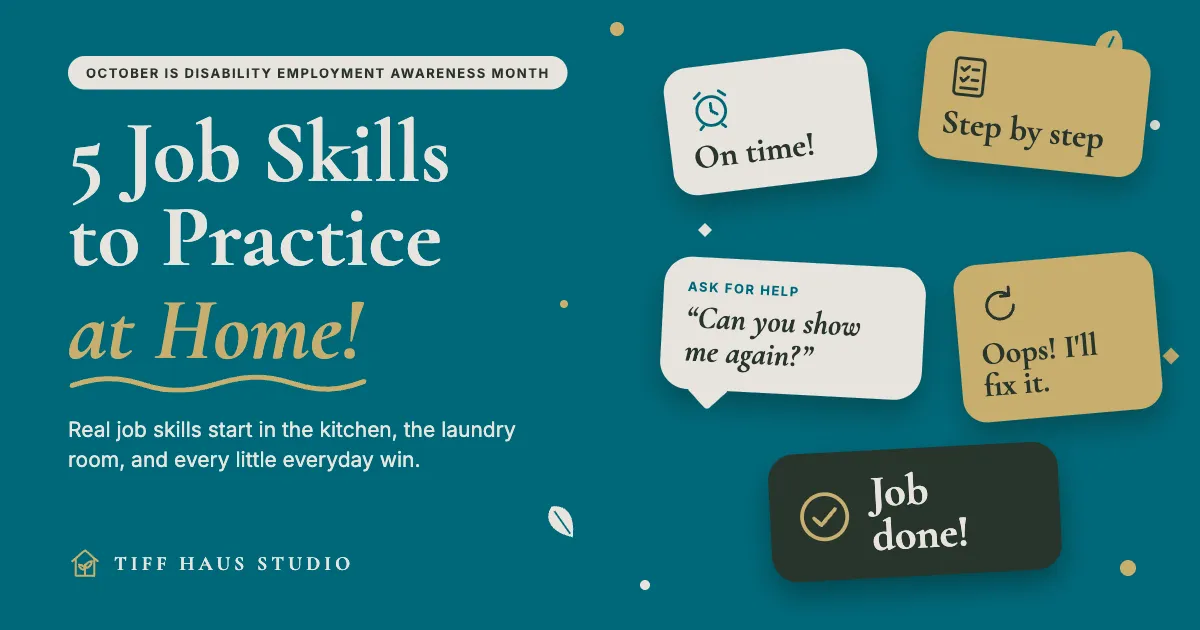
October Is Disability Employment Awareness Month: 5 Job Skills to Practice at Home
Every October, the country celebrates National Disability Employment Awareness Month (NDEAM). It's a time to recognize the contributions of workers with disabilities and to push for workplaces where everyone has a real shot at meaningful work.
If you're the parent of a teen or adult with an intellectual or developmental disability, this month can bring up a lot. Maybe you're excited about what's possible. Maybe you're quietly wondering, "Could my child actually hold a job?"
Here's the truth: job readiness doesn't start with a job application. It starts at home, in everyday moments you already share. The skills employers value most aren't complicated. They're habits, and habits can be taught!
Let's celebrate this month by practicing five of them together.
Why Job Skills Start at Home
Most jobs, whether bagging groceries, stocking shelves, working in an office, or volunteering at a community center, depend on the same core skills: showing up, following directions, asking for help, handling mistakes, and finishing the task.
Home is the perfect training ground. It's familiar, low-pressure, and full of real tasks. When your loved one practices these skills in the kitchen or the laundry room, they're building confidence they'll carry into any workplace.
1. Showing Up On Time
At work, this looks like: Arriving before a shift starts, ready to go.
Practice it at home:
Give your loved one a real "start time" for a daily task, like "Dishes start at 7:00."
Use a phone alarm or visual timer. Let them set it.
Work backward together: "If we leave at 9:00, when do you need to start getting ready?"
Tiff's Tip: Try not to be the human alarm clock. Every time you remind them, you're doing the skill for them. Let the alarm do the job, and celebrate when they beat it.
2. Following Multi-Step Directions
At work, this looks like: Hearing or reading a set of instructions and completing them in order.
Practice it at home:
Start with 2–3 step directions: "Grab the towels, fold them, and put them in the hall closet."
Build up to 4–5 steps as confidence grows.
Use picture or written checklists for longer tasks. Many workplaces use them too, so this is a real work tool.
Tiff's Tip: If a step gets missed, ask "What's next on your list?" instead of pointing it out. It builds the habit of checking the list, which is exactly what they'll need on the job.
3. Asking for Help (the Right Way)
At work, this looks like: Speaking up when something is confusing, instead of guessing or freezing.
For many adults with IDD, this is the hardest skill on the list. Plenty of people have been taught to go along quietly rather than ask questions. Asking for help is a form of self-advocacy, and it's one of the most valuable things they can learn.
Practice it at home with simple scripts:
"Can you show me that again?"
"I'm not sure what to do next."
"Can you say that slower, please?"
"Where do I find ___?"
Write these on a card they can keep in a wallet or on their phone. Then practice. Give a direction that's a little unclear on purpose, and cheer when they ask about it.
Tiff's Tip: Always respond to a question with appreciation: "Great question. Thanks for asking." We want asking for help to feel safe, not embarrassing.
4. Handling Mistakes and Feedback
At work, this looks like: Hearing "That's not quite right" and fixing it without shutting down.
Practice it at home:
Model it yourself. When you make a mistake, say it out loud: "Oops, I forgot the soap. I'll fix it."
Teach a go-to response: "Thanks for telling me. I'll fix it."
Give small, kind feedback during chores and let them practice the response.
Tiff's Tip: Mistakes aren't the problem. Shutting down after a mistake is. The goal isn't perfection. It's recovery.
5. Staying On Task Until the Job Is Done
At work, this looks like: Finishing an assignment before moving on, even when it gets boring.
Practice it at home:
Choose tasks with a clear finish line: emptying the dishwasher, sorting laundry, wiping every counter.
Use a timer for work periods, with a short break built in.
End with a "done check." Ask them to look it over and tell you when it's finished.
Tiff's Tip: Let them experience the satisfaction of finishing. Resist stepping in to do the last few items yourself, even if it's faster.
Your October Practice Plan: One Skill a Week
You don't have to tackle everything at once. Try this simple plan:
Week 1: Showing up on time
Week 2: Following multi-step directions
Week 3: Asking for help
Week 4: Handling mistakes and feedback
All month long: Finishing the job
At the end of each week, talk about it together: What went well? What felt hard? What do you want to keep practicing?
A Note for Parents
It's natural to want to protect your loved one from frustration or failure. But every time we step in too fast, we send a quiet message: "I don't think you can do this."
You're not failing if this feels hard. You just haven't had the right tools yet. Let's change that.
Start small. Give real responsibility. Let them struggle a little, then celebrate the win. That's how confidence grows, one task at a time.
Frequently Asked Questions
What is National Disability Employment Awareness Month?
National Disability Employment Awareness Month (NDEAM) is observed every October in the United States. It celebrates the contributions of workers with disabilities and promotes inclusive employment practices.
When should my child start practicing job skills?
Now. Whether your loved one is 16 or 36, it's never too early or too late. Everyday tasks at home are the best place to start.
What if my adult child isn't ready for a paid job?
That's okay. Volunteering, internships, and supported employment programs are all great stepping stones. Every skill practiced at home still counts.
Where can I find employment support for adults with disabilities?
Start with your state's Vocational Rehabilitation (VR) agency, your student's IEP transition team if they're still in school, and local disability organizations that offer job training or supported employment.
Next Steps
Pick one skill from this list and start practicing this week.
Write out the "asking for help" scripts and put them somewhere your loved one can see them every day.
Have a conversation about work. Ask your loved one what kind of job sounds interesting to them, and really listen.
Explore the Independence Academy for step-by-step lessons, skill cards, and trackers that make practice easier.
Feeling unsure where to start? Book a free Clarity Call and we'll map out your family's next step together.
Independence can be taught, and your family doesn't have to figure it out alone!