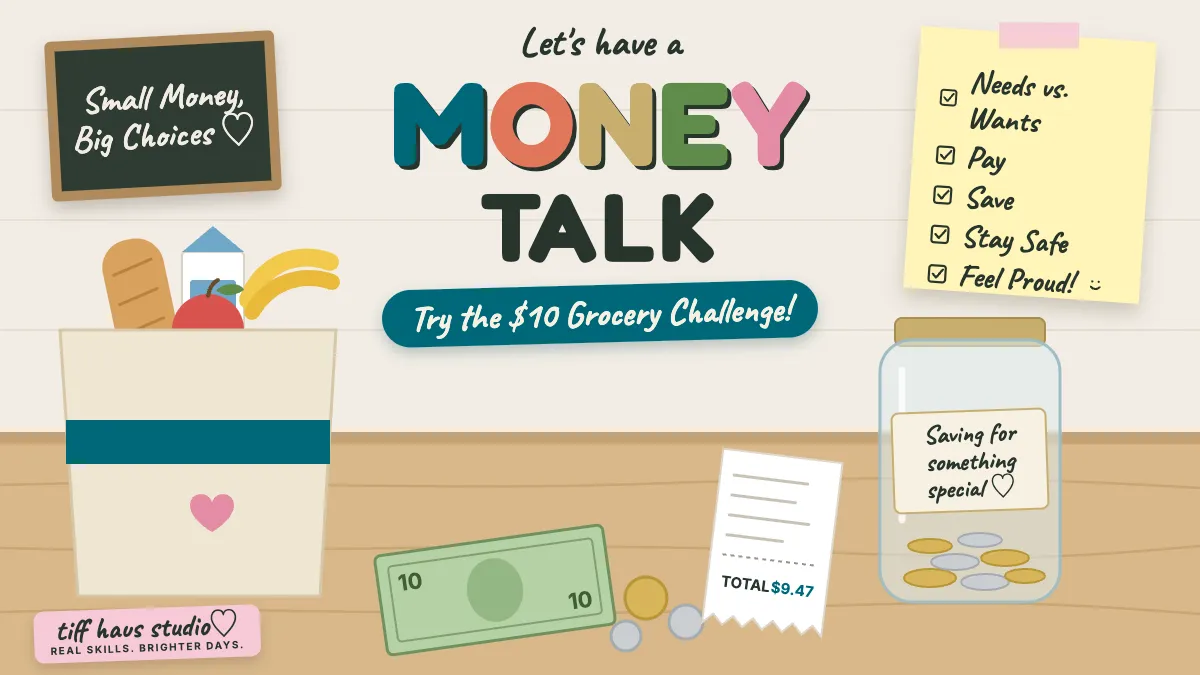
Money Talk: How to Help Your Adult Child Handle Their Own Money
Of all the independence skills, money is often the one parents hold onto the longest. And that makes sense. Money feels high-stakes. Mistakes can cost something, and nobody wants to see their loved one taken advantage of.
But here's what we see again and again: money isn't really about math. It's about choice. When your adult child can handle their own money, they get to decide what to buy, what to save for, and how to spend a Saturday afternoon. That's independence you can hold in your hand.
The good news? Money skills can be taught in small, safe steps, starting with just a few dollars.
Start With the "Why"
Before you teach counting or budgeting, talk about what money does. Ask your loved one:
"What's something you'd love to buy for yourself?"
"Where would you like to go if you had your own money?"
"What do you think it costs?"
When money is connected to something they care about, learning it stops feeling like a lesson and starts feeling like freedom.
5 Money Skills to Build, One Step at a Time
1. Knowing Your Money
What it looks like: Recognizing bills, and knowing whether you have enough to pay.
Not everyone needs to count exact change, and that's okay. One simple strategy many people use is the "one more dollar" method: if something costs $4.29, hand over the dollars you see ($4), plus one more ($5). It's quick, reliable, and works almost everywhere.
Tiff's Tip: Calculator apps and payment cards are real tools, not shortcuts. The goal is getting it done confidently, not doing math the "school way."
2. Needs vs. Wants
What it looks like: Understanding that some things come first.
Sort a few items together into two piles: needs (toothpaste, bus fare, lunch) and wants (a new video game, a fancy coffee). There are no wrong answers at first. The conversation is the lesson.
3. Paying at the Register
What it looks like: Handing over money or a card, waiting for change, and taking the receipt.
Practice it:
Role-play at home with real bills and a "cashier" (that's you).
Then practice at a quiet store at a slow time of day.
Teach one simple script: "Can I have my receipt, please?"
Tiff's Tip: Stand back, even a few steps. When you're right there, the cashier will talk to you. Let your loved one own the moment.
4. Sticking to a Budget
What it looks like: Knowing how much you have to spend and making choices that fit.
This is where the fun comes in. (See the $10 Grocery Challenge below!)
5. Saving for Something Special
What it looks like: Setting money aside for something bigger.
Pick a goal together, like a new pair of headphones or a concert ticket. Use a clear jar or a simple tracker, and color in progress each time they add money. Watching the goal get closer is powerful motivation.
Try This: The $10 Grocery Challenge
Ready to put it all together? Here's how it works:
Give your loved one $10 (cash works best to start).
Pick a mission together, like "Buy what you need for a lunch" or "Get snacks for movie night."
Make a short list before you go. Pictures work great.
At the store, they're in charge. They find items, check prices, and decide what fits.
They pay using the "one more dollar" method or their card.
Debrief at home: What did you get? Did you stay under $10? What would you do differently next time?
Went over? Forgot something? That's not failure. That's learning, and it only cost ten dollars. Try it again next week and watch the confidence grow.
Money Safety: The Skill That Protects All the Others
Adults with disabilities can be targets for scams and financial exploitation, so safety belongs in every money conversation. Practice these rules together:
Your PIN is private. Never share it, even with friends.
Never send money or gift cards to someone you met online or on the phone.
If someone pressures you about money, pause. Say: "I need to talk to someone first."
Have a "money buddy," a trusted person they can always check with before a big purchase.
Tiff's Tip: Role-play the tricky moments. "What would you say if someone at the bus stop asked to borrow $20?" Practicing ahead of time makes it easier to say no in the moment.
A Note on Benefits
If your loved one receives SSI, Medicaid, or other benefits, the amount they save or keep in the bank can affect eligibility. Before opening accounts or building savings, talk with a benefits counselor, and ask about ABLE accounts, which are designed to help people with disabilities save without putting their benefits at risk.
A Note for Parents
Letting go of money control can feel scary. Start small: a few dollars, low-stakes purchases, and plenty of room to make mistakes. A $3 mistake today is far better than a $300 mistake later without the skills to prevent it.
You're not giving up protection. You're building it into them.
Frequently Asked Questions
How can I teach my adult child with a disability to manage money?
Start with small amounts of real money and real-life practice, like paying at a store or sticking to a $10 budget. Build one skill at a time: recognizing money, paying, budgeting, saving, and staying safe.
What if my loved one can't count money?
They can still handle money. Strategies like the "one more dollar" method, calculator apps, and debit cards help many adults pay confidently without counting exact change.
Should my adult child with IDD have a debit card?
Many adults with IDD use debit cards successfully, especially with low balances, spending alerts, and a trusted person who helps review statements. Start with cash first if that's easier to learn.
Will a bank account affect SSI benefits?
It can. Savings above certain limits may affect SSI and Medicaid eligibility. Talk with a benefits counselor, and ask whether an ABLE account is a good fit.
How do I protect my adult child from financial scams?
Teach simple safety rules (keep your PIN private, never send gift cards, check with a trusted person first) and practice them through role-play.
Next Steps
Have a money conversation this week. Ask what your loved one would like to buy or save for.
Try the $10 Grocery Challenge and debrief together afterward.
Practice the money safety rules with a quick role-play.
Not sure where to start? Book a free Clarity Call and we'll map out your family's next step together!
Independence can be taught, and your family doesn't have to figure it out alone.